
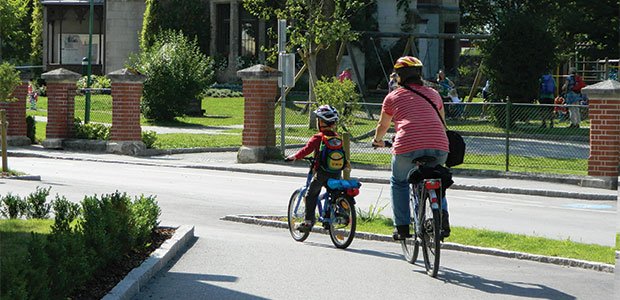

If you’re looking to contribute to environmental sustainability while reaping health benefits and bonding with family, consider active transportation. This approach involves leaving your vehicle behind and using your own energy to travel to nearby locations.
Healthy Families
Engaging in activities like walking and biking enhances our cardiovascular health, strength, flexibility, and bone density. These forms of exercise also positively influence mental well-being, affecting self-esteem, anxiety levels, and depressive symptoms.
It’s crucial for young people, especially children and teens, to engage in physical activity as their bodies grow, with the foundation of 90% of bone mass being built by adulthood.
Building Connections
One less obvious advantage of active transportation is the opportunity it provides for social interaction. Riding bikes or walking with family members fosters deeper connections.
For instance, Carolyn Conrad accompanies her 10-year-old daughter, Natalia, on daily walks to school. “On the way home, she opens up about her day in spontaneous ways. She shares observations and thoughts,” Conrad notes.
These moments allow for joyful exchanges and help establish strong social bonds that benefit both children and adults. For adults, these connections can alleviate stress and anxiety, and may even reduce inflammation and the risk of certain cancers. Children gain from increased self-esteem and are encouraged to engage with new surroundings.
Social interactions are vital for children’s emotional and social development, assisting them in resolving conflicts, comprehending emotions, and nurturing empathy.
As Conrad illustrates, “Once, while passing a bus shelter, Natalia noticed a woman who seemed upset. This shows her growing empathy and compassion.”
Take Your Time
Catherine O’Brien, PhD, an associate professor at Cape Breton University, has spent over 14 years studying children’s perspectives on transportation. She believes that active transportation aids in “preserving the essence of childhood.”
Rather than being confined to adults’ hurried transportation mindset—which prioritizes speed—children can explore, discover, and take joy in their journeys whether walking or biking to school.
O’Brien explains, “Walking offers children an opportunity to engage with their surroundings in a patient manner, free from adult time constraints.”
The Pursuit of Joy
Active transportation is closely related to O’Brien’s notion of “sustainable happiness,” which refers to achieving joy without negatively affecting others or the environment.
This concept highlights the link between environmental sustainability and happiness, emphasizing how our welfare is connected to both people and nature.
O’Brien’s recent study explores the relationship between active transportation and sustainable happiness. A survey about the emotional experiences of children and parents during their school commute revealed that both groups reported heightened positive emotions when traveling actively.
Her research will soon be published in the Journal of School Health.
Link to Academic Success
In addition to nurturing curiosity and happiness in kids, leaving the car behind can also benefit their academic performance.
A recent study showed that teenagers who engaged in just 12 minutes of physical exercise achieved better results on attention and reading assessments compared to those who did not, with these benefits lasting about 45 minutes—sufficient time for an early morning English exam.
Encourage Walking!
When it comes to allowing children to walk alone, many parents often cite concerns about “stranger danger” and potential abduction as the main reasons for driving their kids to school.
While these fears tend to be more imagined than actual threats, Jacky Kennedy, Director of Canada Walks, recognizes that addressing infrastructure and traffic safety concerns can be challenging for parents alone.
Fortunately, there is support available. The Active & Safe Routes to School initiative, which Kennedy helped develop, is a nationwide movement advocating for active transportation for students. The program includes strategies like the Walking School Bus, where parents take turns escorting groups of local children to school.
According to Kennedy, walking or biking gives parents the chance to teach their children about community safety, fostering awareness of their surroundings and how to respond in various situations. “This kind of engagement with your child doesn’t happen if you don’t take time to walk together,” she emphasizes.
Get Moving!
The 2014 Active Healthy Kids Canada Report Card evaluates the physical activity levels of children and youth. While Canada excels in organized sports, parks, and physical education policy, it lags behind other nations in overall physical activity rates.
Still, there are numerous opportunities to remain active within our communities. Instead of driving, consider:
- cycling to your grocery store or next event
- in-line skating to visit a friend or family member
- walking with your children to their after-school activities
- organizing or taking part in a weekend scavenger hunt
Global Celebration of Walking
October marks International Walk to School Month (IWALK), a worldwide celebration that raises awareness about active transportation and its related issues, promoting the Active & Safe Routes to School program within communities.
For further details, visit the IWALK website at iwalktoschool.org.