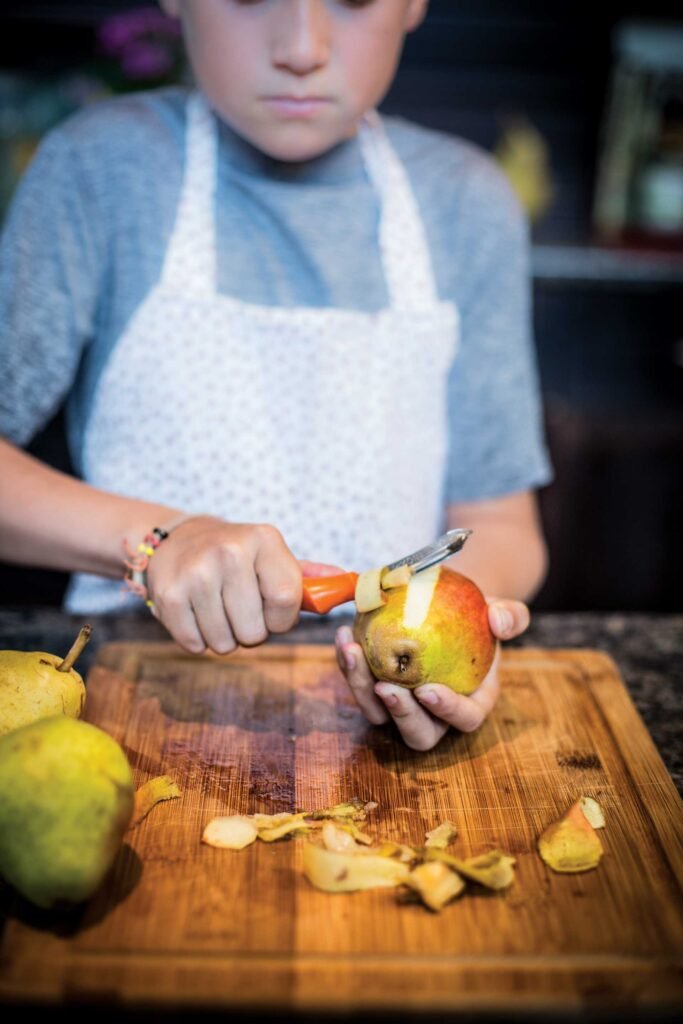

To my immense satisfaction, my eight-year-old son Alister is busy preparing a dessert. That’s right—he’s peeling pears, with a serious expression and his tongue poking out in focus. Once he finishes peeling and coring, the pears will be poached and paired with a citrus-flavored panna cotta. Quite impressive for a third grader, don’t you think?
Cooking with Kids
Meanwhile, Alister’s older brother Cameron, aged 12, is busy chopping onions. The tears are flowing, but with Chef Carl Heinrich—winner of Top Chef Canada and co-owner of the renowned restaurant Richmond Station—overseeing the kitchen, there’s no chance he’s going to quit. Not now, especially with Bolognese sauce for fifty people to prepare.
This evening, the boys and I are participating in a program called Kids Cook to Care (KCTC) at the Massey Centre in East York. This innovative nonprofit offers young volunteers the opportunity to prepare meals for individuals in underserved communities, allowing them to gain hands-on kitchen experience while learning about various ethnic cuisines. Tonight, they are teaming up with eight other children, ranging from six to sixteen years old, to prepare an Italian feast for expectant and new mothers residing at the centre.
A Unique Initiative’s Origin
KCTC was established in 2009 by Toronto mothers Jill Lewis and Julie Levin. “We noticed a lack of genuine volunteer opportunities for younger children in Toronto. So, I thought, why not place them in a kitchen, pair them with a celebrity chef, and let the magic unfold?”
“We previously lived in New York and volunteered at a shelter on the Upper West Side,” Lewis recalls. “After relocating here, I promised my children we’d continue to cook and provide care in Toronto, but no one would allow us to work in their shelters or soup kitchens. They were only open to adults or kids ten and older. So, together with a friend, we decided to take action and see if we could create change.”
The Significance of Volunteering
When Lewis invited me to join KCTC, I eagerly accepted, looking forward to involving my two sons. Like many well-intentioned but busy families, I had long sought a hands-on volunteering experience that would enable them to make a genuine impact while interacting with those in need. Unfortunately, I never took the time to find the right opportunity. As a result, our efforts to contribute often consisted of making monetary donations to various charities, which can feel somewhat abstract for children.
Moreover, this opportunity aligned perfectly with my approach to showing love and care for others through cooking. Much like the countless women who have baked casseroles before me, I believe in expressing love through food—in times of difficulty or grief, as well as during celebrations, like welcoming a new baby. And in our day-to-day life, I strive to nourish my family with wholesome meals, at least during the good weeks.
Heinrich expresses a deep connection to KCTC. “I can relate to the program and the experience of the kids cooking at the Massey Centre. My mother became a parent at 19 and I was her second child. Our family faced challenges that were likely more difficult than most.” His culinary journey began in his teenage years, as he began cooking to help his mother, who was a single parent working full-time to support three children.
“My older sister and I cooked together once a week. That’s the reason I chose this meal, as the sauce was one of the first dishes I prepared for my family. I would come home from school, open canned goods, brown the ground beef, prepare the sauce, and then my mom would tell me when the pasta was ready. This experience ignited my passion for food. We rarely dined out and didn’t have access to expensive ingredients; our meals often consisted of ground beef and frozen chicken, but we managed to eat well on a budget.”
Empowering Kids with Skills
As the remnants from Heinrich’s initial pots of spaghetti sauce were repurposed into lasagna and later into chili, the kids at KCTC prepared ample amounts of onions and mushrooms. With some help from mothers managing the stirring of the hot industrial stoves, they made enough sauce to ensure the young women would have a substantial amount left over.
Next, the younger participants rolled the pasta dough into long shapes, while the older ones cut them into pieces, using their thumbs to craft various pasta forms. Fueled by Heinrich’s prompt, the young cooks sprang into action, ensuring the kitchen was spotless before the meal could be served. The other mothers and I exchanged glances, marveling at their collaborative efficiency!
They then assembled an efficient line to plate the pasta, sauce, salad, and garlic bread. The youngest helper—six-year-old Grace—joyously carried plates from the counter to the residents, many of whom were holding babies.
To arrive at the Massey Centre on time, I had taken the kids out of school slightly early, a choice I made easily given the invaluable experience. Once all guests were served, the children joined the residents at their tables, finally ready to enjoy the pasta they had worked so hard on. My boys sat beside a young woman who did not yet have a child. “Stay in school, kids. Don’t skip classes; it’s a slippery slope.”
I always felt certain, but I couldn’t help but think that this single moment made it worthwhile for my children to miss the last period of school that day.