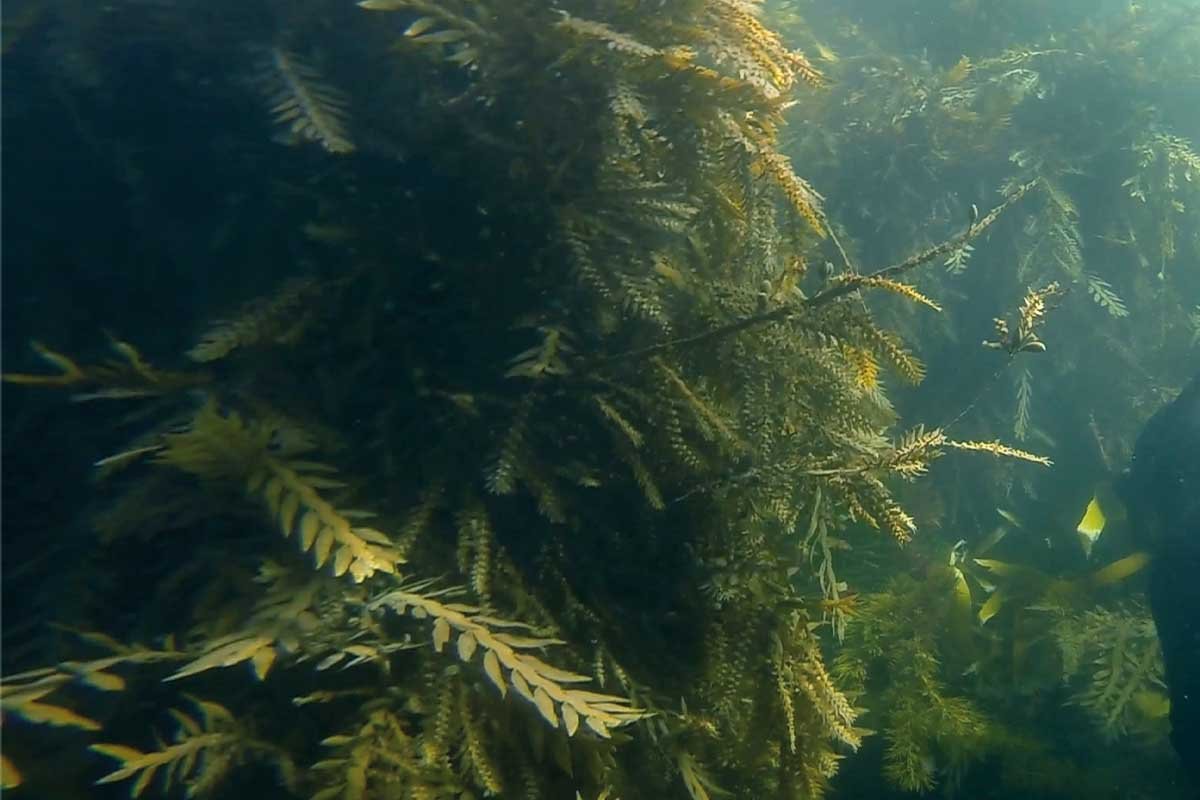

Dan McNeill Gwiisihlgaa dons his scuba equipment, grabs his two-foot-long rake, and takes his catch bag as he immerses himself in the waters surrounding Haida Gwaii, an archipelago off British Columbia’s northern shore. He’s searching for urchins, ready to use his metal tool to gather the spiky sea creatures and place them in his bag.
This is McNeill’s contribution as the marine stewardship director of the Council of the Haida Nation to help protect the region’s diminishing kelp forest.
“It’s sustenance for us,” he reflects about the extensive brown algae. “It symbolizes our culture and defines our identity.”
Fostering Seafood Growth
McNeill’s underwater excursions formed part of the “Chiix̱uu Tll iinasdll: Fostering Seafood Growth” initiative aimed at revitalizing a kelp forest area in Gwaii Haanas from 2017 to 2021.
The purpose behind collecting urchins was to help rebalance the local ecosystem. Once prevalent in the region, sea otters were key predators of urchins until their extinction during the maritime fur trade of the 18th and 19th centuries.
With the absence of these predators, urchins have skyrocketed in numbers, leading to severe overgrazing of kelp, a vital resource for the Haida Nation, which also plays a critical role in sustaining the planet’s biodiversity and ecology.
Kelp thrives along coastlines globally and provides nourishment and habitat for essential marine life. Just as terrestrial forests do, kelp’s photosynthesis process captures carbon dioxide, nitrogen, and phosphorus while releasing oxygen—playing a crucial role in mitigating climate change. Its contribution to fisheries and nitrogen absorption results in over $500 billion in annual global revenue.
However, the Haida Nation is not alone in facing the issue of kelp depletion. Over the past five decades, more than half of the world’s kelp forests have experienced declines, posing risks to coastal biodiversity, water quality, and atmospheric carbon dynamics.
A Neglected Crisis
Underwater ecosystems are vanishing at alarming rates attributed to threats such as habitat destruction, overharvesting, pollution, and overgrazing. Additional challenges stem from climate change and sedimentation due to soil runoff from deforestation, dredging, and storms. Although ocean conservation has been a concern for decades, efforts to protect and restore kelp are relatively new.
“The ocean is often overlooked compared to terrestrial environments, and even within the ocean, most conservation efforts focus heavily on coral reefs,” Eger explains, noting the bias that shapes funding and resources for conservation initiatives. “This bias creates layers that determine where our conservation resources are allocated.”
A 2021 study published in the Frontiers in Marine Science journal quantified this oversight, revealing that for each mention of kelp forests, seagrass meadows were referenced seven times, salt marshes 20 times, coral reefs 38 times, and mangroves 43 times.
A Worldwide Initiative
In 2023, Eger’s organization kicked off the Kelp Forest Challenge, a global endeavor urging all stakeholders—from individuals to corporations and governments—to commit to restoring 1 million hectares and protecting an additional 3 million hectares of kelp habitat by 2040.
Efforts to revitalize and conserve kelp ecosystems begin with pinpointing their decline’s root causes. Strategies may include managing urchin populations or addressing polluted waters and sedimentation, alongside seeding or introducing juvenile kelp to foster new growth.
“We are still in the early stages, but I believe we are on a good trajectory,” Eger states regarding the commitments being monitored via a dashboard established by the organization to provide public updates on the project’s development. “However, it will demand greater international cooperation and a larger, unified restoration initiative.”
Countries like Japan and Korea have lengthy histories of restoration efforts, while regions like California and Washington state are creating frameworks for conservation and restoration. Presently, the Kelp Forest Challenge stands as the only international conservation movement targeting this issue.
An Interconnected Ecosystem
In Haida Gwaii, the principles and values of the Haida Nation guide their practices. The concept of Gina ‘waadluxan gud ad kwaagid, which translates to interconnectedness—recognizing that all elements rely on each other—underscores the ecosystem’s delicacy and susceptibility. This principle is what McNeill emphasizes when discussing the decline of kelp in the region.
“The sea otter played a crucial role in managing urchin populations, and with their absence, the entire ecosystem shifts,” McNeill observes. “This highlights the interconnected nature of our ecosystem.”
This article was initially published in the April 2025 edition of up7op magazine.